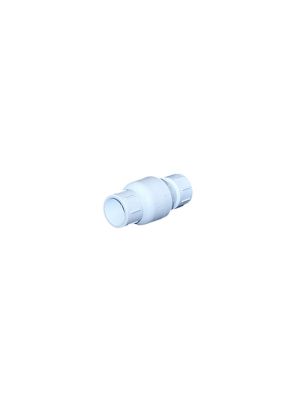

Check Valves
Soval supplies non-NSF PVC check valves to wholesale distributors who need reliable, cost-effective flow control solutions. Our inventory is for distributors who stock industrial and commercial piping products, with a deep selection and order flexibility to keep your customers supplied. Whether you're fulfilling a large project order or restocking fast-moving SKUs, our PVC check valve line is ready to ship.
Types of PVC Check Valves We Carry
Our non-NSF PVC check valve line consists of two spring-loaded series, each designed for a specific end connection type. Both are rated to the same performance standards and built for the industrial and commercial applications your customers specify.
450 Series — PVC Socketed Spring Check Valves
The 450 Series is our socket-end PVC spring check valve, designed for solvent-weld installation into PVC piping systems. The spring-loaded mechanism provides fast, positive seating to stop backflow without relying on flow velocity alone, making it a more reliable option than swing-style valves in low-flow or variable-pressure systems. It has a maximum temperature rating of 120°F, meeting ANSI standards.
451 Series — PVC Threaded Spring Check Valves
The 451 Series offers the same spring-loaded backflow prevention in a threaded end configuration, making it the right fit for systems that require removable connections or where solvent welding is not practical. Like the 450 Series, it has a maximum temperature of 120°F and meets ANSI standards. The threaded design simplifies installation and allows for easier field replacement when maintenance is needed.
Common Applications for Non-NSF PVC Check Valves
Non-NSF PVC check valves are specified for numerous industrial and commercial settings.
Chemical processing operations use PVC check valves for their corrosion resistance in acid and caustic fluid systems. The material holds up where metal valves would deteriorate.
Irrigation and agricultural water management systems are another high-volume application. Non-NSF PVC check valves prevent backflow in drip and sprinkler systems, protecting pump equipment and maintaining pressure zone integrity.
Industrial wastewater and general drainage applications frequently call for non-NSF PVC check valves as well. In these systems, backflow prevention protects equipment and facility infrastructure without the material cost of stainless or bronze alternatives.
Pool and spa equipment, HVAC condensate lines, and aquaculture systems round out the common use cases for PVC check valves.
Why Wholesale Distributors Choose Soval for PVC Check Valves
Soval focuses on the wholesale distribution channel. That focus shapes how we stock, price, and fulfill orders for PVC check valves and the rest of our valve inventory.
We maintain a deep inventory of high-turn items so distributors can place orders with confidence that the products are available. When your customer has a project timeline, backorders on basic fittings and valves are not an acceptable answer.
We also stock a broad range of complementary PVC valves, including ball valves and butterfly valves, so distributors can consolidate sourcing rather than splitting orders across multiple suppliers.
Request a Quote on PVC Check Valves
If you're stocking non-NSF PVC check valves for your distribution customers, Soval makes it straightforward to get pricing and confirm availability. Browse our full selection and submit a quote request or contact our team directly.
Frequently Asked Questions About PVC Check Valves
NSF-certified valves meet NSF International standards for contact with potable water. Non-NSF PVC check valves are not certified for drinking water contact, so they're specified for industrial, chemical, agricultural, and other nonpotable applications. If your customer's end use involves any potable water system, they must specify an NSF-61-certified product.
Our PVC check valves are rated to 150 PSI at 73°F (room temperature). Pressure ratings decrease as temperature increases, so installers working in higher-temperature fluid environments need to derate accordingly. Always check the manufacturer's pressure-temperature curve before specifying.
PVC has good chemical resistance to many acids, bases, and salts, which is one reason PVC check valves are common in chemical processing applications. However, PVC is not compatible with all chemicals. Ketones, esters, aromatic hydrocarbons, and chlorinated solvents can damage PVC. Distributors should confirm chemical compatibility with the specific fluid before recommending PVC.